
These three chapters conclude the first phase of the tale of Bhaerlogge.
5
Stood then the shepherd, full of fury,
Indignant anger aroused in his heart,
Bade the brute, Bhaerlogge, be on his way.
Quoth he: “Return not unto this region.
Though god thou art, thou art no more than Gunn.
Great Hounds we’ll set against thee in sentry!
Gunn shall beware Gunnbathu.”
“Warmer reception from wolves I received!”
Gaily laughed Bhaerlogge, “Gunn I may be!
Threats I fear not, nor the teeth of thy wolfhounds,
And I would eat flesh ere I fare on my way.
Step aside, shepherd! Yield up thy sheepfold!
Well now thou knowest thou art not my match;
Again I will not ask thee.
“By my breath, Bhaerlogge, I will not oblige thee!
I have let nothing, though a lion descend!
Thou art a beast, bent on blood for thy belly,
No food hast thou known other than what thou huntest.
Though great be the beast, it must bend to man’s mastery.
Be as a man, and man’s food I’ll give thee,
But the sheep are the life of a shepherd!”
Bread brought the shepherd, then, cheeses and beer,
And Bhaerlogge feasted on man’s food at last.
Ate he fifteen loaves, ten flagons he drained,
Ten bowls of milk and the curds in their bowls.
It seemed to the shepherd that he’d never stop,
Until finally Bhaerlogge downed the last bowl.
Laid bare was the shepherd’s larder.
“Pray, what is thy name, o new friend, and kinsman?”
Bhaerlogge asked, from his tower of trenchers.
“I am named Cullevin, surnamed Mag-Cuor.”
The Shepherd said, shaking his head at the scene.
Bhaerlogge beamed and the beer flagons tumbled
Before the feet of Culleven Mag-Cuor.
“Hast thou some food for the road?”
“I have nothing more! Thou hast eaten it all!”
Bemoaned Cullevin, cursing his own good will.
“Great Hounds I’ll set yet to ward off this Hunger!”
To Bhaerlogge turned and bid him on his way,
With a bow like a servant, he saw the boy off.
No more a brute was Bhaerlogge now;
For man’s food a man had made him.
With the sun overhead, now southward he went.
Long was the way to the wide mountain span.
The hills grew higher, dark mounds, deadmen’s howes,
Where long had lain folk of the Mhochainn, great warriors.
Here had pitched battle been fought near the foothills,
And blood flowed where yawned the boulder-built gate
Of the fortress: Dunach Fraghrte.
6
Evening came when his wanderings ended.
Bhaerlogge stood at the mouth of the cave;
A great crevice gaped and its breath drew him in.
This crack in the cliffside his fate now contained.
Stepping inside, either wall was earth-hewn
By the gods who had fashioned these mountains of old.
Ancient as Yrne was this pathway.
Through darkness, a doorway was opened about him,
Behind him was harrying darkness enclosing.
Bhaerlogge strode on, encased in silence;
The stillness of stone bearing strong down upon him.
Fear preyed upon him and pried at his ribs,
But Bhaerlogge fought it and boldly continued,
Though he knew he was not alone.
The crevice continued forever it seemed,
And Bhaerlogge thought that the shepherd deceived him,
Until at last the long road was ended
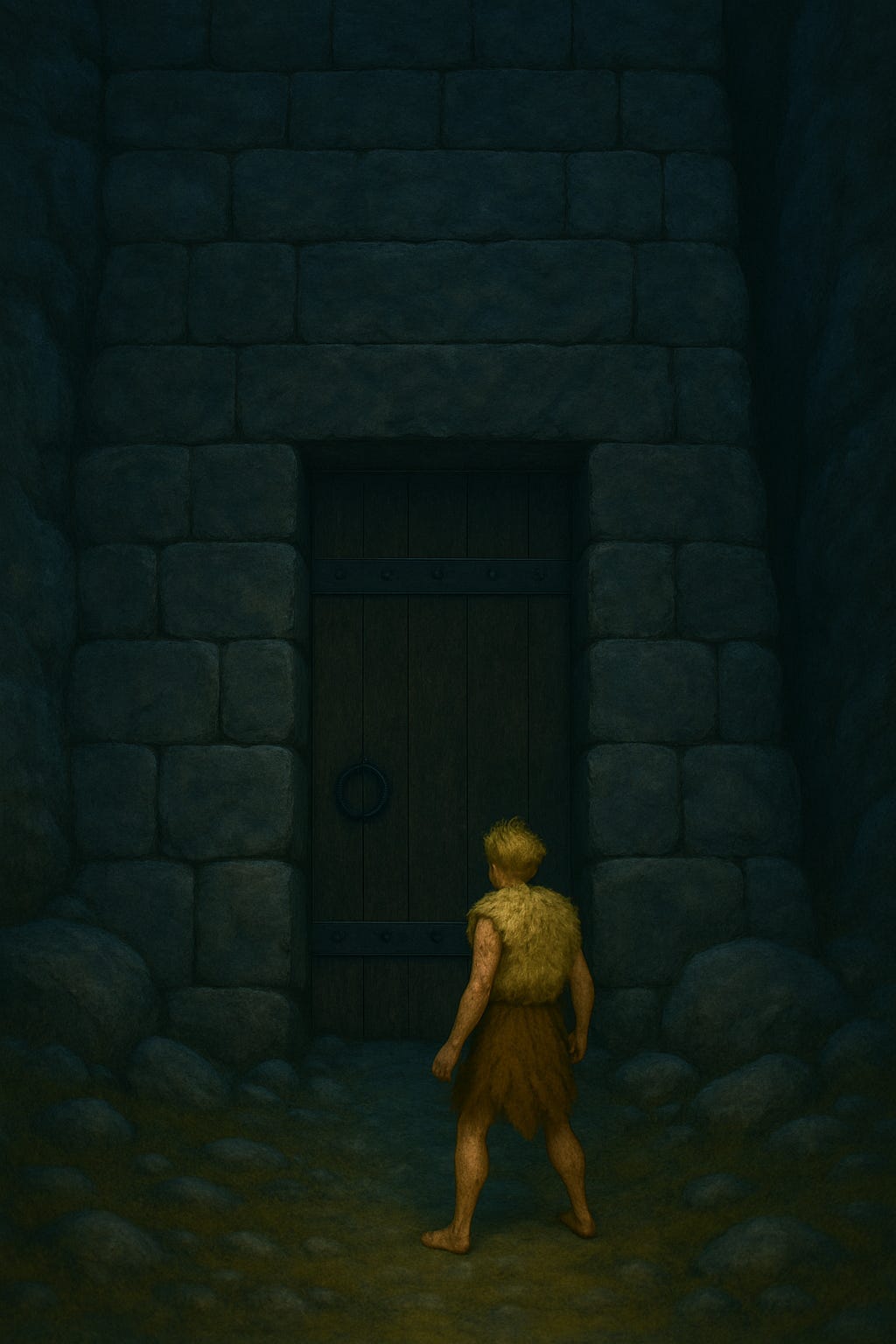
Abruptly when Bharlogge faced a stone wall.
Different it was than the cliff faces ‘bout him,
For it was built of great boulders, smooth-weathered.
And a small door was set at its center.
“Hail, stranger!” A voice cried from high up above him.
Atop the stone wall there stood a sentry.
“What business brings you here, bearing no weapons?
A wanderer here will find no welcome!
Turn back and tell no one of this place you’ve seen!”
“Alert thy master!” Baerlogge answered.
“I am his son, come to slay him!”
The sentry exclaimed and his post was soon empty.
A voice heard Bhaerlogge, calling the steward.
A clamor arose and through chasm echoed
The sound of clear voices and cries of concern.
Alone stood Bhaerlogge in front of the door,
Awaiting his answer, ready to give challenge.
For revenge he now was ready.
Though all was dark in the chasm about him,
Bhaerlogge saw through the stone wall a light,
Arise like a flame of great fire, leaping,
As all of the court was awakened. He waited.
The clamor was cut short, and cold silence settled,
And taught was the air with the anticipation
As the master now approached.
The door was flung open and Bhaerlogge, blinded
By firelight, strained to see the form before him.
Braced he for battle, yet no battle came,
For the master laid no blow on him.
When his eyes were healed and he again saw
The figure before him, he stood in awe.
Withered with age was the man.
7
“What do we have here? Who is this child?
A mere lad has been sent to slay me?”
The man stood in wonder, Bhaerlogge in same.
“Name thyself, boy! I’ve not before seen thee!
Yet thou sayest of me I am thy father.
Come, step inside, in the fire I’ll see thee,
For clouded my eyes are with age.”
“I am Bhaerlogge, avenger of Faerre!
If thou art my father, I am sent to slay thee!
Here was I sent, by Cullevin the shepherd,
Who told me thou knewest a faerie in love.”
Beckoned was Bhaerlogge beyond the great walls,
And in the bright torchlight he saw then the face,
Gray of hair, skin, and of eyes.
“Cullevin Mag-Cour truly has told thee.
Long ago knew I in love a faerie,
Ages ago it was, yet the keener
I remember it now for the run of the years.
Faithless their kind, as a brand it burns me.
Immortal folk cannot find satisfaction
In the loving of mortal men.”
“Tell me,” said Bharlogge, “What is thy name?
I ween I do not know thee, old man.”
The withered man laughed, and wrinkled head bowed:
“My name I’ve lost in the river of life.
Here by my servants I am called San.
San-Fraghrte they call me, or the Father of Forty.
Many my sons, who serve me.”
“Wert thou called Fralla?” Asked Bhaerlogge, fearing
That he had failed in Faerre’s requesting.
“I cannot say who I was long ago,
Only that I can remember that faerie.
Dark was she, dreamlike, deadly as poison.
Dark was her woodland, a Walde in the west.
Dark as the wood was our child.”
“Then thou art not my father!” Cried Bhaerlogge, wailing,
For now he had failed to find his father.
“Wherefore have I come? Now my quest is ill-ended!
What more canst thou tell me? Is my hope lost?”
“Nay,” said San-Fraghrte, “Thy quest is not done.
“A wanderer art thou, akin to the wolves.
A Vagabond, Way-Bound, thou art.”
“Canst thou not tell me a thing of my father?
Am I doomed the dust-roads ever to wander?”
“I cannot tell thee, for tied is my tongue.
Thy fate shalt thou find of thy own faring.
Westward and south hast thou gone, come from east.
Northward now go and a name I shall give thee:
Lokka Fag-Guinnas! Long-Strider!”
Pronunciation Guide
A- Ah (ä- between A and E)
E- Ey (ë- brighter E, almost EE)
I- EE
O- Oh (ö- between O and E)
U- OO as in “Food”
Y- OO as in “Foot”
All diphthongs favor the accented vowels.
AI- (Stressed) Eye, (Unstressed) Ay
C- Always hard
CG- Hard J sound
CH- as in “Loch”
DH- TH as in “The”
GH- Softer CH, like a hard H
Ʒ- Y sound as in “Yes” or “Day”
MH- W as in “Water”
This is quite interesting, Van. It almost reminds me of Oedipus, but there are several differences, of course.
I think you could probably lean even more into the Beowulfian alliteration. It came on fairly strong in the first part, but I feel like it’s less noticeable in the form of the poem in the second two parts.
I’ve said similar things before, but all these echoes of the old tales coming together to form something new is really wonderful.
One thing: In stanza 6, there’s a typo. “Taught” ought to be “taut”.