
In this section of the story, Bhaerlogge reveals his wolfish nature. The hunt for Fralla begins.
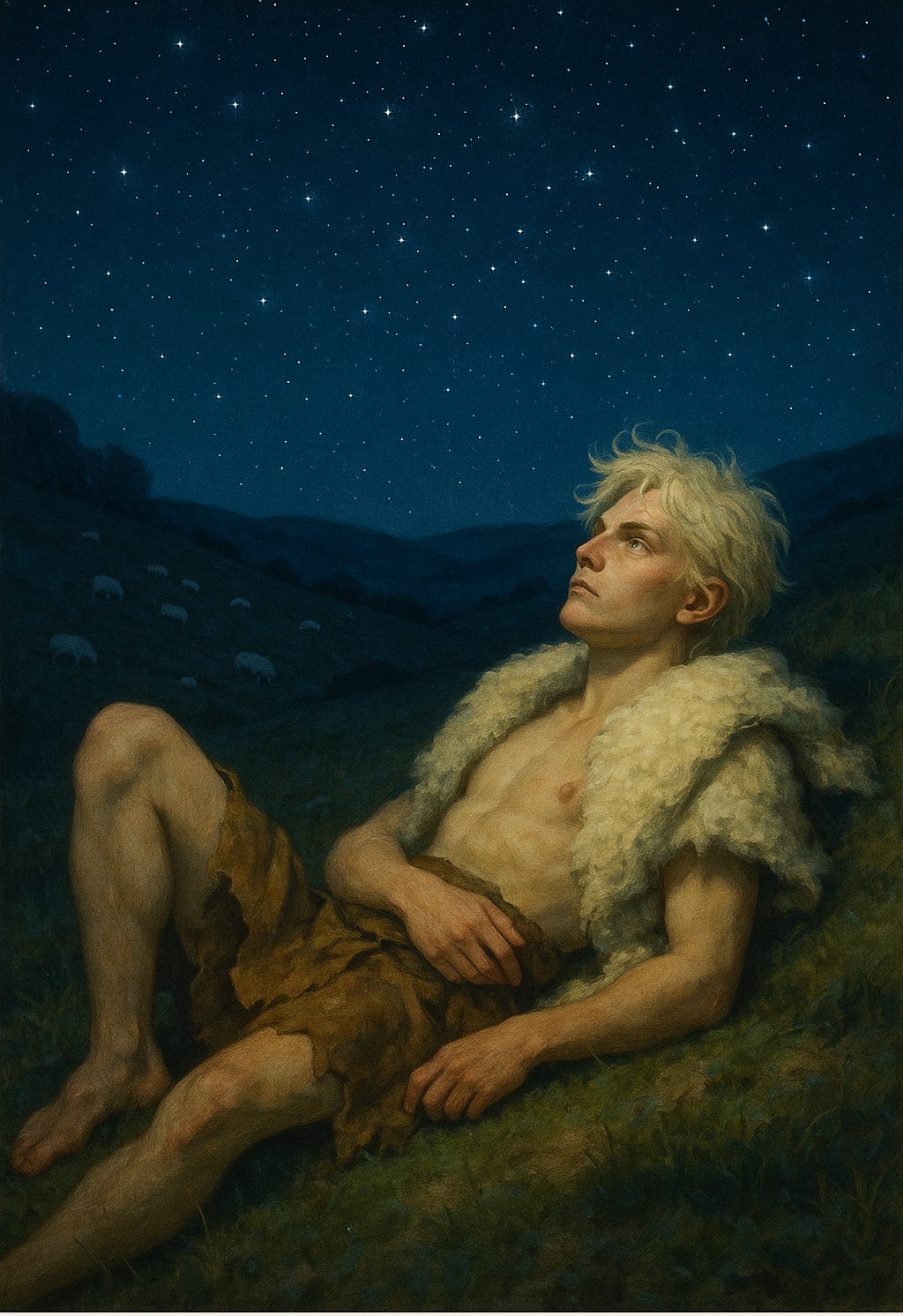
3
With these words sent off, newly named Bhaerlogge,
Faerre’s son went forth to find his father.
Long roaming forest, yet finding no one,
His spirit aflame grew fiercer and fuller,
So keener burned the candle of his heart,
And sharper still he searched.
Finally come to the forest’s end,
Bhaerlogge veered from his westerly course,
Fralla dwelt not in the forested lands.
West nothing yielded, now to the south
To mighty mountains he made his way.
Now over hills in the highlands.
Long had Bhaerlogge no game-blood lacked,
But wolfless and wide was the Westlands’ span.
He drank from the waters he found on his way,
Yet naught of food found, but of nagging need.
When last he saw that his strength was all spent,
A village he spied in far vale.
With last waning strength made his way to the wold,
A beacon of hope in the barren grass-lands.
A lone-wolf alike, he had lost his way,
Like a ravenous wolf, his belly revered.
Mind filled with famine, he was mad for meat;
But a bowl would bring back his life.
Bhaerlogge furious, gaunt-faced and fearsome,
Sought out a meal to assuage his stomach.
But a dog found, and that did he kill,
Of the kin of his kindred that brought him up.
Fiercely he rent it and ravaged its meat,
And strength in his stomach he felt.
Unaccustomed to kith, knowing no consequence,
Wot he not what in his hunger he’d done.
Off to the sheep-fold, unfilled by his feeding,
He knew only hunger as animals know.
Seized he a lamb from its mother’s side,
And ate he it whole, to the fleece.
The fleece he kept, and by it made bed,
And slept he that night under the bright sky.
When morning dew woke him, he took up his fell,
But ere he could set off he heard a great cry.
Bewildered he turned to the clamor here caused,
And bit he the blade of the shepherd.
4
But strong as the oakwood was Bhaerlogge’s skin,
And the blade that had struck him he cast away quickly.
The shepherd afraid of this awesome stranger,
Eyes filled with fire, bid him to speak.
“Who art thou,” he asked, “And whence art thou come?
“Be thou a god, that my blade thou felt not?”
Bharlogge, taken by sight of a kinsman,
Who only before had the Guinnain race known,
Now hungered for answers, his human need holpen,
And said to the shepherd “I seest thy soul.
“I ken that thou art of my race akin,
“Though not of my strength, it seems.”
“I am Bhaerlogge, avenger of Faerre,
“A Wood-Spirit’s son, only wolves have I known,
“Thou art kin to me, that much is clear,
“Art thou my father, by Faerre called Fralla?”
This so he spoke and the shepherd was stunned,
And answer he gave on dry tongue:
“I know not thy face, nor thy inhuman fire,
“I am not thy father, though father I be.
“I reckon that I would remember the time
“If ever I felt the embrace of a Faerie.
“Yet, I have heard of one who has.”
Thus spoke the shepherd, shaking.
“Whom dost thou know? Answer straghtaway!
“Where is the one of whom thou speakest?”
Bhaerlogge driven by vengeance aflame
Held aloft, lusty-sinewed, the shepherd by the neck,
“Answer straightway or my bloodlust I’ll sate
“With thee, then find my father.”
The farmer, afraid made a retching reply,
He felt Bhaerlogge’s grip, firm about him.
“By the way in the hills is the home of this one
“Who child begat by a faerie, long before.
“His name I know not, nor know of his lore,
“But the only I know of his kind!”
“In the cleft of the cliffs in the southerly mounds,
“In a crevasse of stone dwelleth the hoary hermit.
“Seldom is seen that sly son of Fynn.
“Whether alive or dead, who can say?
“Seek him if thou seest fit, but slacken thy hand!”
So Bhaerlogge gave up his grip.
Pronunciation Guide
A- Ah (ä- between A and E)
E- Ey (ë- brighter E, almost EE)
I- EE
O- Oh (ö- between O and E)
U- OO as in “Food”
Y- OO as in “Foot”
All diphthongs favor the accented vowels.
AI- (Stressed) Eye, (Unstressed) Ay
C- Always hard
CG- Hard J sound
CH- as in “Loch”
DH- TH as in “The”
GH- Softer CH, like a hard H
Ʒ- Y sound as in “Yes” or “Day”
MH- W as in “Water”
I’m really enjoying this. I reread the first couple stanzas before these so that I could get a better feel for the poem as a whole. It flows really well and there is a feeling of growing suspense as the story progresses. I do think that the alliteration in the first installment was stronger as a whole, but I think that’s because there’s more action in this installment. It seems the lines describing a character or something else are (generally) stronger than the sections of dialogue or action, which has been the case for me when I’ve attempted alliterative verse.
I’ve not attempted to write a long narrative poem yet. This is really impressive.
I enjoyed this but felt that the first part of the poem was poetically superior to it.
(Also, it’s straightaway not straghtaway, you may want to fix that.